Welcome to my Blog.

Translate my Posts easily.

Welcome to my blog.

I'll be posting thoughts, photos, happenings, and other art
related information from time to time.


If English is not your most comfortable language please use
the Google translator on the right for fast translation of my Posts.

Thank you.
Visualizzazione post con etichetta monuments. Mostra tutti i post

lunedì 26 maggio 2014

A Pleasant Surprise!!

This trompe-l'oeil in the courtyard entrance to Palazzo Martelli invites you to discover yet another secret treasure in the center of Florence. An out-of-the-way palace not usually on tour guide visits but my Saturday morning surprise, a guided tour, by a friend.

Museum of  Casa Martelli, a home-museum unique of its kind, created by a noble family over the centuries, and not the result of reconstruction and arbitrary integration. The complex and exhibition includes sculpture and paintings of the 17th and 18th centuries.

The majestic staircase that leads to the museum

We arrive at the museum after climbing this monumental staircase. At the top, at one time, the statue  "Il Giovanino" by Donatello reigned. (Now in the Bargello)

"Il Bagno"   ( The Bath )
 Completely decorated with trompe-l'oeil affrescos, this room is called the Bath. In the recessed area  to the right  a marble bathtub is set among the ivy and flowers depicted in the fresco. The dimmly lit room is  suggestive enough on its own but Saturday  morning a string quartet concert was scheduled at 11 and they were rehearsing here while we looked on. Four young and accomplished musicians.

The ballroom where concerts are held.

But, the sights that really were amazing to see were the rooftop views of Florence and her monuments as seen from a terrace  that is being restored at the top of the museum.  We were priviledged to see the city from there. I confess that I didn't have my camera with me so these pics  are off the web.  Sorry!  It won't happen again........
Florence rooftop view

rooftop view


mercoledì 16 aprile 2014

A DAY OUT. . .


Renaissance  Florence and the Etruscan Tomb
Take a walk with me to visit one of the Etruscan Tombs that make up the history of  Florence.


This Etruscan tomb, named the Tomb of the Montagnola,   consists of an artificial mound of earth of about 70 meters in diameter. Discovered in 1959, it dates back to the mid-seventh century B.C. and is located at the outskirts of the city of Florence.

Here we are approaching  the entrance.


Look at the approach to the door of the tomb, those huge slabs of rock at the left, somehow hand cut and placed one above the other, form the entrance way.


Clay, softened and thick, was the only mortar used
to keep these stones in place.


This is what we saw beyond that small iron door at the entrance.

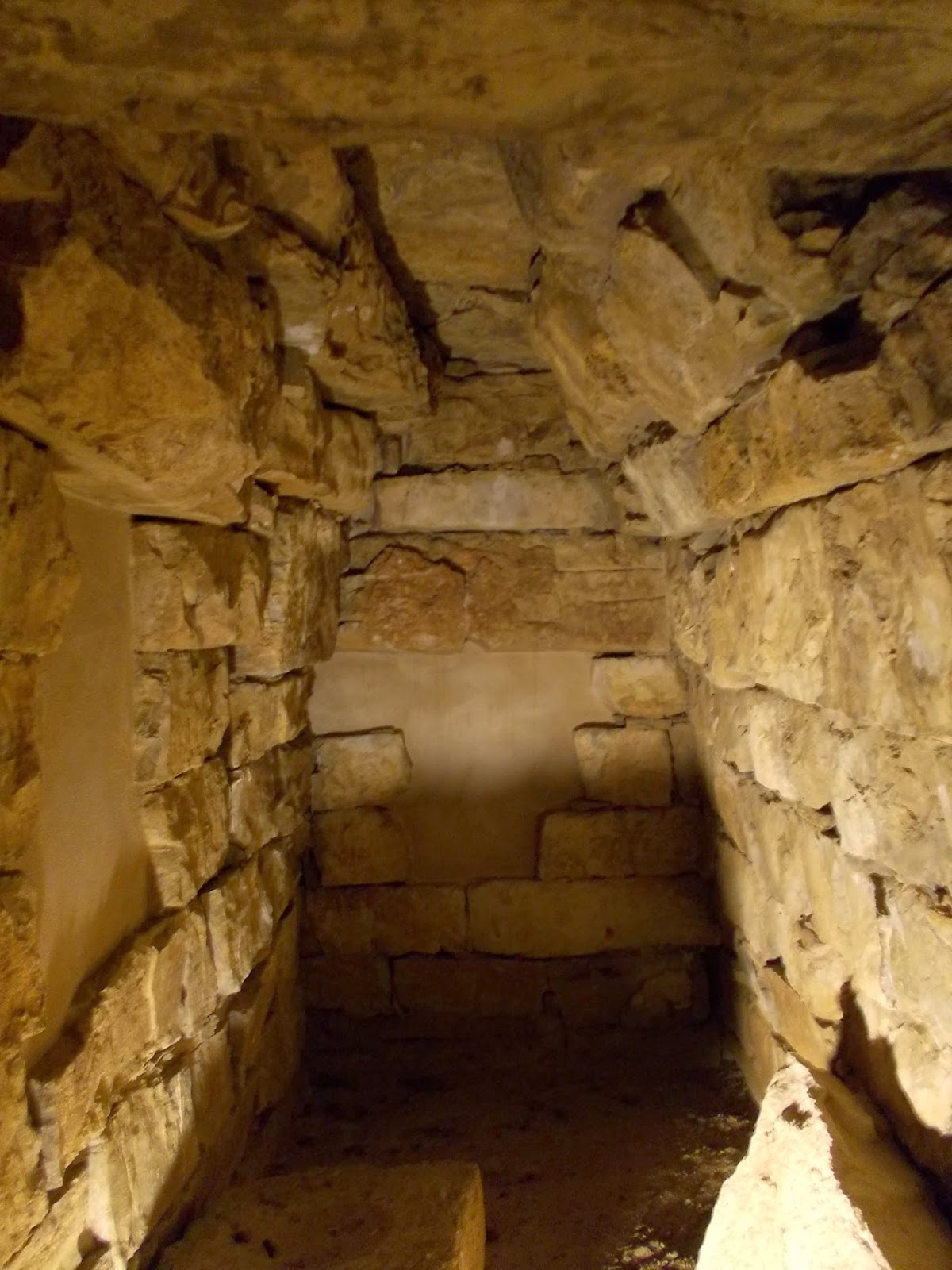
The structure of the Barrow or mound consists of  an external corridor, an internal vestibule with two lateral cells and a final circular chamber with a dome-shaped roof and central pillar.

This is the vestibule or main corridor. To the left and right are the two small chambers and ahead, beyond the passage in the center is the circular chamber.

Notice the ceiling and the placing of the stones that form the roof.  They are in an inverted V shape and remind us of the engineering feit achieved by Brunelleschi when he built the dome of the cathderal in Florence. The blocks of stone, at times a few meters wide, were arranged in overlapping rows up to the top of the construction ending in an acute arch.


 I couldn't help but admire the warm, golden color of the rough stones which were carved from  nearby Monte Morello.


This is the the small chamber to the left of the main corridor.

Again note the amber tones of the rocks and the huge blocks that were used.


 This is the small chamber to the right.


Here is the circular chamber with its central pillar that doesn't touch the ceiling but stops just a few inches before.


Again, look at the amazing circular placement of the stones on walls and ceiling.


There was a sense of quiet and peace within the walls of this tomb. Amazement at the simplicity of the  structure. . ..            wondering at the people who dwelled within.


mercoledì 25 dicembre 2013

ON CHRISTMAS DAY. . .

  A MORNING OF TIMID SIGNS . . . a possible sunny day. . . then  high winds steadily swept in thick grey clouds. . .  but no rain . . . that was our Christmas day here in Florence. There was a highlight for me though. . .
The Certosa Monastery
..  the setting of the Christmas Mass. . . which every year is held in  the museum of the monastery of "The Certosa of Galuzzo", constructed in 1342. This  monastery  sits high on a hill at the south of the city of Florence and is where the famous painter, Pontormo, (1494 - 1557), lived and worked for a brief period.

The museum where Pontormo's work is shown and where Mass is held


It's always difficult for me to concentrate on the religious rituals when I am here.  I can't take my eyes away from the frescos.  They were realized in the period of 1523- 1525 and originally placed in the large Cloister of the monastery. Ruined by time and inclement conditions, the pigments are faded in part, but the  strength and innovation of Pontormo's work is notable. He was a pupil in the school of Andrea del Sarto  together with another famous painter of the Renaissance and Mannerism, il Rosso Fiorentino.

The frescos found in this room are part of the series of the Passion of Christ.

"The Deposition of Christ"

"The Resurection"

"The Oration in the Garden"

Can you wonder that I am distracted?  Every visit is a new emotion!

http://en.wikipedia.org/wiki/Pontormo . . "
In 1522,when the plague broke out in Florence, Pontormo left for the Certosa di Galluzzo, a cloistered Carthusian monastery where the monks followed vows of silence. He painted a series of frescoes, now quite damaged, on the passion and resurrection of Christ."
http://www.frammentiarte.it/dal%20Gotico/Pontormo%20opere/12%20storie%20della%20passione.htm

lunedì 2 settembre 2013

“. . .All Aboard!!!”


The Trainmedici art show 001

I took a day off the other day to go into Florence, something that is getting to be rare for me. What I mean is that I went into the city just for me, just to wander around. . . to window shop . . .and to meet a friend. Its fun just to do nothing in particular and let things happen without a plan.
The idea was to go to the flower market that’s held every Thursday in the center. It turned out that we went to an art show instead and then on to a long, chatty lunch.

A visit to Palazzo Medici Riccardi, a museum that features temporary exhibitions,  was  the real surprise of the day. We found three exciting exhibits, each totally different. One was the show by an Irish sculptor, Paddy Campbell, whose large bronze statues were in the courtyard as well as in the garden. But the pieces that struck me most were three realistic and funny Scenes placed in a small room off the main gallery: the Train,(see foto above) the Market, and a Bedroom. They were scenes of daily life populated by wax figures 1/3 of the natural dimensions, including hundreds of small objects, accessories and costumes of the period, all narrating  stories of normal, everyday people. The largest scene represented the Market of Sant’Ambrogio, Florence’s bustling central market place, full of stalls, customers buying, the salespeople hawking, plus all the natural surrounding caos; dogs barking, babies in buggies, etc., etc.

medici art show 004
Sant'Ambrosio Market (part.)
medici art show 005
Sant'Ambrosio Market (part.)
medici art show 003
Sant'Ambrosio Market (panaramic viiew)
                                           Take a close look at these photos to see the details


          The second show was a three room exhibition  by an “unidentified” artist.
medici art show 007
mixed media on paper, wood panel
medici art show 006
tempera on paper, wood panel

     That is, the artist had refused to put his name on the exhibition forcing us to go back to the bookshop for info. Armodio is his name, an artist of international fame.(He participated in the 2011 Biennial in Venice) His work has an aura of metaphysical silence and whimsical irony that is incredible and fascinating.

Then the third show. Not a “show” as such because it is a visit to the second floor of the Medici Riccardi Palace which is always visible.  I  just hadn’t been for years.
The highlight, after seeing the decorative rooms and  furnishings, was seeing the frescos in the chapel done by Benozzo Gozzoli entitled “The Procession of the Magi”. Breathtaking!! really. (visit the web site to see all)

Will do this more often.
image
detail of the fresco
image
fresco in the Magi Chapel

http://www.palazzo-medici.it/mediateca/it/index.php
http://www.palazzo-medici.it/

sabato 16 marzo 2013

Primavera and Botticelli

note the grass dotted with wild flowers, the floral motif on the dress of the maiden at the right
 

After so many weeks of dark days and torrential rains and no painterly inspiration, today is splendid! A strange and beautiful day. In the early morning we started out to attend a funeral, alas, but  the sun, ablaze in the most pure blue sky ever,  eased  the sadness of our journey. A brief service. .  . simple . . . a reminder that our existence is temporal, that the joy and beauty of life should be our guide . We had the usual Saturday grocery shopping to do, supplies for the week, etc.,etc. But suddenly I wanted to take a detour. Since we were near one of the most important Medici villas in Florence, we decided to make a stop there to basque a little in the warmth of this premature sun and to see the gardens which, as I remembered, at this time of year are a joy of spring flowers; blue hyacinths, tiny red anemones, yellow daffodils and miniature tulips, white, red, violet, all mixed haphazardly with the grass or in formal rows hidden in  niches created by the  boxwood hedges. Think of the garden depicted in the Primavera by Botticelli. This garden must have been in his mind as he painted.

I wanted to take pictures,  closeups of these flowers, to immortalize details of this enchanted garden but, as usual, no camera! (sigh. . . the story of my life) The next best thing was my husband's cell phone but even that is useless because I can't seem to download them. Until I have better photos, I have posted some that are pertinent to the garden I saw today.


full view of the formal garden


giovedì 14 febbraio 2013

Valentine's Day

The courtyard of the Bargello  Museum
How really fortunate I am to live in Florence, Italy, where every street and every square takes you through a page of an art history text.  This morning, with a group of friends, I visited the Bargello Museum which houses primarily sculpture . . . and what sculpture!! From medieval masterpieces to works by Donatello, Michelangelo, Ghiberti and Brunelleschi, and Della Robbia just to mention a few.

We are having a mild winter and today, I'm sure, as a St.Valentine Day gift, the sun is shining and the temps were very mild considering that we are in the month of February. This was a valentine from me . . to me!! (and to you!).


Amazing staircase in the courtyard
 Unfortunately, no photographs  can be taken inside the museum, only in the courtyard.

The Bargello, also known as the Bargello Palace, Museo Nazionale del Bargello, or Palazzo del Popolo (Palace of the People) is a former barracks and prison, now an art museum.

The palace was built to house first the Capitano del Popolo and later, in 1261, the 'podestà', the highest magistrate of the Florence City Council. This Palazzo del Podestà, as it was originally called, is the oldest public building in Florence.
 
note the coat of arms on the wall

 It was also employed as a prison; executions took place in the Bargello's yard where my pictures were taken until they were abolished by Grand Duke Peter Leopold in 1786, but it remained the headquarters of the Florentine police.
Fountain decoration in marble

This museum  is a MUST during your visit in Florence.


Della Robbia glazed terracotta rosone


Various coat of arms on the walls of the courtyard