Welcome to my Blog.

Translate my Posts easily.

Welcome to my blog.

I'll be posting thoughts, photos, happenings, and other art
related information from time to time.


If English is not your most comfortable language please use
the Google translator on the right for fast translation of my Posts.

Thank you.

sabato 14 giugno 2014

The Monuments Men

Up to now I never knew much about  the Monuments Men.


When a few years ago the press and TV spread news about  George Clooney buying  rights to a book about soldiers in World War II called the Monuments Men,  I thought it  interesting but nothing more. Maybe there weren’t enough  details about these men and their mission  to catch my interest at the time.

Then, just over a month ago, I received this invitation in my mail:
 Uffizi gallerij
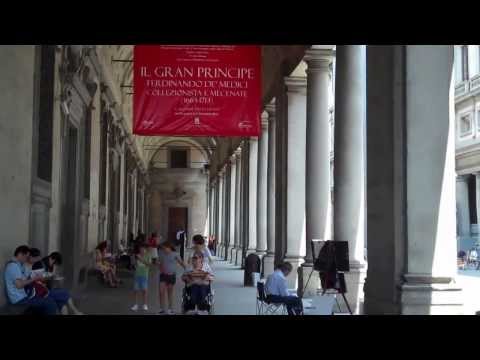
The Loggia of the Uffizi Gallery.  The door to the library is on the left.

 Ilaria Dagnini Brey's talk on 'Saving Italy's Art during the War' is on Monday 5th May, at the  Biblioteca degli Uffizi, at 5 p.m

Memorial Day was coming soon and there were plans in the air for  celebrating the 70th anniversary of the Allies landing in Europe. I decided to attend for two reasons: to see the Uffizi library as well as to hear the  speech not knowing that she would be talking about these Monuments Men.


pmf
The beautiful library of the Uffizi Gallery. The small door at the center opens onto the Loggia of the Uffizi.
 The speaker, Ilaria Dagnini Brey, is a journalist, Italian but now living in NYC with her family. She  learned of the monuments men, the subject of her 2009 book, while researching the 1944 bombing of Ovetari Chapel in Padua, Italy, her hometown. Much of her research was done in this very library in the Uffizi. Her book, "The Venus Fixers", was written much before the book "The Monuments Men" by Robert M. Edsel which was the base for George Clooney's film.

It could have been the amazing setting of the library, it could have been the gentle speech of this lovely woman, her vibrant enthusiasm, but now I wanted to know more about these men and the valorous work they did during the war. Never having experienced war on my own homeland, I was eager to know more about what had occcured in Florence, my new home, suddenly realizing the danger that all of her art treasures had faced.

The two dramatic photos below are taken from Mrs. Brey's book and from her article at the link below.

Thick black smoke clouding the sky over Florence's Duomo and the bell tower after a bombing raid.


Michelangelo's David.A wall of bricks was built to protect him  during bombing raids.
http://www.smithsonianmag.com/history/how-monuments-men-saved-italys-treasures-180948005/


The amazing thing about these men is that they were all scholars, architects, art historians,  and artists
in their own right. And they were low ranking soldiers sometimes unable to convince officials to listen. Some had spent time in Italy studying and knew the language therefore being valuable to the allies for translation. Along with some of the  Italian superintendents of museums, these men were instrumental in  saving  much of Italy's treasured art from German pilfering and bombing.

The difficulties were many, lack of transportation, shortage of gasoline, etc., but the effort was
spontaneous and strong. The huge statues and paintings that are now taken for granted in all of the most famous museums in Europe were removed from their peaceful settings to safer places in the outskirts of important cities to avoid possible bombing, ruin and theft.

I have just finished Mrs. Brey's book and, recently, have been to a lecture by Mr. Edsel on his book "The Monuments Men", and am about to start  the most recent book by Robert Edsel, "Saving Italy", which will become a movie soon. I recommend that you, too, read about this mission  ignored for too long.

Robert Edsel, at the end of his lecture, posed this question to his audience: In your opinion, if a choice had to be made between saving a work of art or a human life, what would be your reaction?


sabato 31 maggio 2014

RED . . . Who's Afraid of the Big, Bad R. . .

Connections   oil on paper applied to wooden panel   50x70cm
Something new!

I have always avoided reds, don't know why, or rather I  do know why . . . too strong, too dominant, too . . too everything I guess. I considered them  too difficult to handle.

But here I deliberately chose red, alizarin crimson red to be exact, ( with touches of cad. red to warm up a little). After my sessions of mentoring with Janice Mason Steeves, I now feel I can defy my self-made taboos and restraints without consequences. It is completely liberating .  I enjoyed working on this piece, a real challenge and intend to continue with reds and new color schemes from here on.

Not only my color choice was liberated but so also was my method.  Again thank you Janice. I began with very thin washes of color (color, oil and turpetine) and watched as they dripped and intermingled down the paper as if they were watercolors. Remembering the importance of tonal contrasts I kept track of the lights and darks as I constructed my composition. Brushes were put aside in favor of spatulas, palette knives and . . . my fingers, also in line with the neccessity to "play" with my paint, to feel it glide onto the support, (which is paper, prepared with gesso and applied to a wood panel.

Again I am continuing my theme of anatomy using the spinal column as the central "figure"!

Just want to show you another "red" painting done awhile ago. There's a difference???? A change?
 
Figures -  oil, cold wax on canvas,  64x47cm


Thank you for visiting.


lunedì 26 maggio 2014

A Pleasant Surprise!!

This trompe-l'oeil in the courtyard entrance to Palazzo Martelli invites you to discover yet another secret treasure in the center of Florence. An out-of-the-way palace not usually on tour guide visits but my Saturday morning surprise, a guided tour, by a friend.

Museum of  Casa Martelli, a home-museum unique of its kind, created by a noble family over the centuries, and not the result of reconstruction and arbitrary integration. The complex and exhibition includes sculpture and paintings of the 17th and 18th centuries.

The majestic staircase that leads to the museum

We arrive at the museum after climbing this monumental staircase. At the top, at one time, the statue  "Il Giovanino" by Donatello reigned. (Now in the Bargello)

"Il Bagno"   ( The Bath )
 Completely decorated with trompe-l'oeil affrescos, this room is called the Bath. In the recessed area  to the right  a marble bathtub is set among the ivy and flowers depicted in the fresco. The dimmly lit room is  suggestive enough on its own but Saturday  morning a string quartet concert was scheduled at 11 and they were rehearsing here while we looked on. Four young and accomplished musicians.

The ballroom where concerts are held.

But, the sights that really were amazing to see were the rooftop views of Florence and her monuments as seen from a terrace  that is being restored at the top of the museum.  We were priviledged to see the city from there. I confess that I didn't have my camera with me so these pics  are off the web.  Sorry!  It won't happen again........
Florence rooftop view

rooftop view


mercoledì 7 maggio 2014

Visiting Pontormo

12 Pontormo - Storie della Passione I have already revealed my love for Pontormo in a previous post.  the  strength and innovation of Pontormo's work is notable. But, yesterday afternoon, my visit to the current show of works by Pontormo and his contemporary, Il Rosso Fiorentino was breathtaking. The vibrant colors, the volumes, the textures of various fabrics, silk, velvet, transparent veiling made me want to touch  as well as look, they were so real.

Fascinating was the famous “Visitation” which was used by Bill Viola as the basis for his video, also in the show, the first room of the show.
(see the link  http://youtu.be/fj17foaKAVU)

I would also like you to see the visit made by Bill Viola  to the studio where the restoration of Pontormo’s Visitation was done in preparation for the show.
 http://youtu.be/ULW45vncMXk

This is a partial view of Viola’s video.
 http://youtu.be/Dg0IyGUVXaQ

The Visitation (1528-29; Parish Church of Carmignano, Italy),  portrays the joyous moment at which Mary tells her cousin Elizabeth that she is expecting a child.
The video by Viola begins with two women--one middle-aged and the other younger--engrossed in conversation. After several minutes pass by, a third woman enters the scene and interrupts the dialogue by greeting the older woman. Through facial expressions and gestures, it becomes apparent that the middle-aged woman knows her well, while the other less so and maybe not at all. The third woman whispers something into her friend’s ear as they embrace, further isolating the other woman. An undeniable awkwardness becomes apparent as introductions are finally made and small talk is exchanged among the three.
Viola wasn’t interested in restaging Pontormo’s painting, He used it to create something new, something more contemporary although in the same spirit of the Renaissance artist’s work.

Pontormo for me is a precursor to Modern painting. He uses  volume and large brilliant color fields in a way that recalls the styles of many contemporary artists.

mercoledì 16 aprile 2014

A DAY OUT. . .


Renaissance  Florence and the Etruscan Tomb
Take a walk with me to visit one of the Etruscan Tombs that make up the history of  Florence.


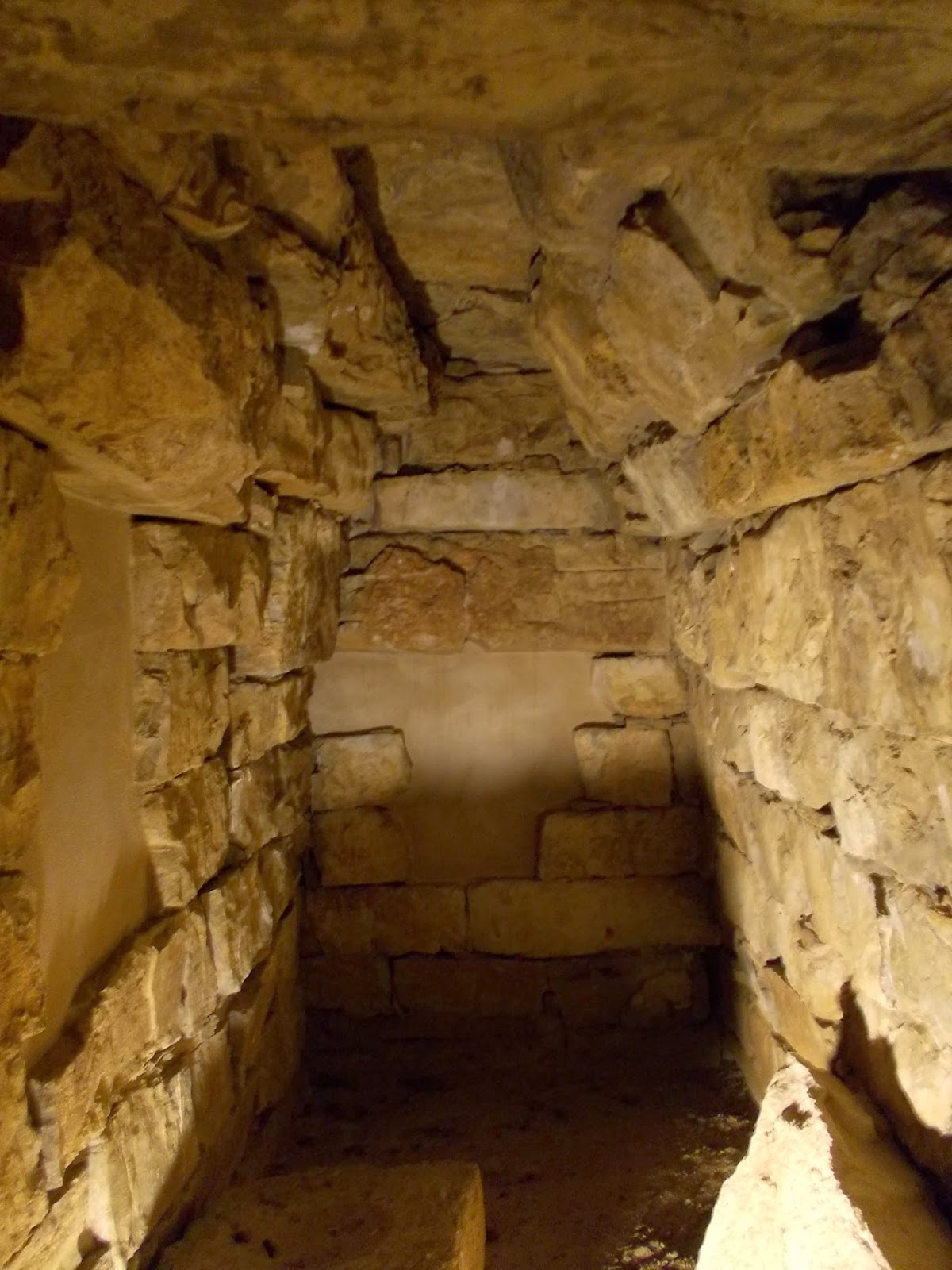
This Etruscan tomb, named the Tomb of the Montagnola,   consists of an artificial mound of earth of about 70 meters in diameter. Discovered in 1959, it dates back to the mid-seventh century B.C. and is located at the outskirts of the city of Florence.

Here we are approaching  the entrance.


Look at the approach to the door of the tomb, those huge slabs of rock at the left, somehow hand cut and placed one above the other, form the entrance way.


Clay, softened and thick, was the only mortar used
to keep these stones in place.


This is what we saw beyond that small iron door at the entrance.

The structure of the Barrow or mound consists of  an external corridor, an internal vestibule with two lateral cells and a final circular chamber with a dome-shaped roof and central pillar.

This is the vestibule or main corridor. To the left and right are the two small chambers and ahead, beyond the passage in the center is the circular chamber.

Notice the ceiling and the placing of the stones that form the roof.  They are in an inverted V shape and remind us of the engineering feit achieved by Brunelleschi when he built the dome of the cathderal in Florence. The blocks of stone, at times a few meters wide, were arranged in overlapping rows up to the top of the construction ending in an acute arch.


 I couldn't help but admire the warm, golden color of the rough stones which were carved from  nearby Monte Morello.


This is the the small chamber to the left of the main corridor.

Again note the amber tones of the rocks and the huge blocks that were used.


 This is the small chamber to the right.


Here is the circular chamber with its central pillar that doesn't touch the ceiling but stops just a few inches before.


Again, look at the amazing circular placement of the stones on walls and ceiling.


There was a sense of quiet and peace within the walls of this tomb. Amazement at the simplicity of the  structure. . ..            wondering at the people who dwelled within.


Digesting my Paintings and Moving On. . .

Connections - 50 x 70 cm  oil on paper

As usual. . . It  takes time for me to digest my paintings!

This last painting, published in the previous post, was missing something that I couldn't put my fingers on.  I
kept constant watch,  looking at it in every way possible,
from a distance, upside down, in black and white as Janice taught me. . .  Until. . . .finally it struck me that it lacked COLOR, strong color.. . . .It was grey and lacked contrast.

So I went to work.  I built up the colors.  Greens and violets that were vibrant and gave it more interest. Lights and darks that reinforced the structure.

And, Voilà.  That is:  Ecco!  Here  you have the last version.

(That is for now!X&zz)

martedì 25 marzo 2014

Playing . . .the Game of Painting


Connections    50x70cm        oil on paper


I have finished the last  painting that I will be presenting to my mentor, Janice Mason Steeves, in a few days.  This time, I can really say that I experienced the "fun" in painting  that Janice has always said is a must.  That loosening up that eliminates any tension, any self created fears of making "mistakes". janicemasonsteeves.art blog.

First, I layed in my lights and darks using an idea from the value studies done previously for Janice. I decided to use a limited palette of blues, yellows, greens and black. My brushes were large as were my spatulas.  I didn't want to fall into the temptation of creating small details and minute forms so LARGE painting instruments were best.

As usual, my forms are  internal anatomical shapes  but this time, once they were in position  in the overall  design, I began to have fun distroying them. At first I used a large, homemade bamboo pen that I made years ago and "drew" into the wet paint breaking up the solidity of the forms. Then, using only my spatula, I built up the negative space around my forms with thick layers of paint concentrating on lights and darks, forms and movement. Again, I wanted to lighten the forms by breaking into them so I chose to use a brayer which picked up  and deposited color  creating movement and light within the forms.  I scraped and rubbed away the color. Nothing was "sacred".  Nothing untouchable.

What I wanted to achieve was a less formulated composition, to express the strength that is an essential part of these forms without making the whole too heavy.

I was in a rush to begin working for my fourth and final session with Janice but I wanted to work on a panel, not canvas.  I  had to wait too long for the delivery of the ordered  panels so decided to work on paper.  I sized the paper with gesso, pinned it to my painting panel and began.  Maybe the use of  paper gave me the strength to mess around, to "distroy" and to go ahead again.


These are the instruments I used. Spatulas, a brayer, my bamboo pen and . . . a Ferrari red spatula sent to me by Janice and "fun" to use.


Thank you for visiting. Hope you will leave a comment.